
Roumaissaa Belkacem
Algeria
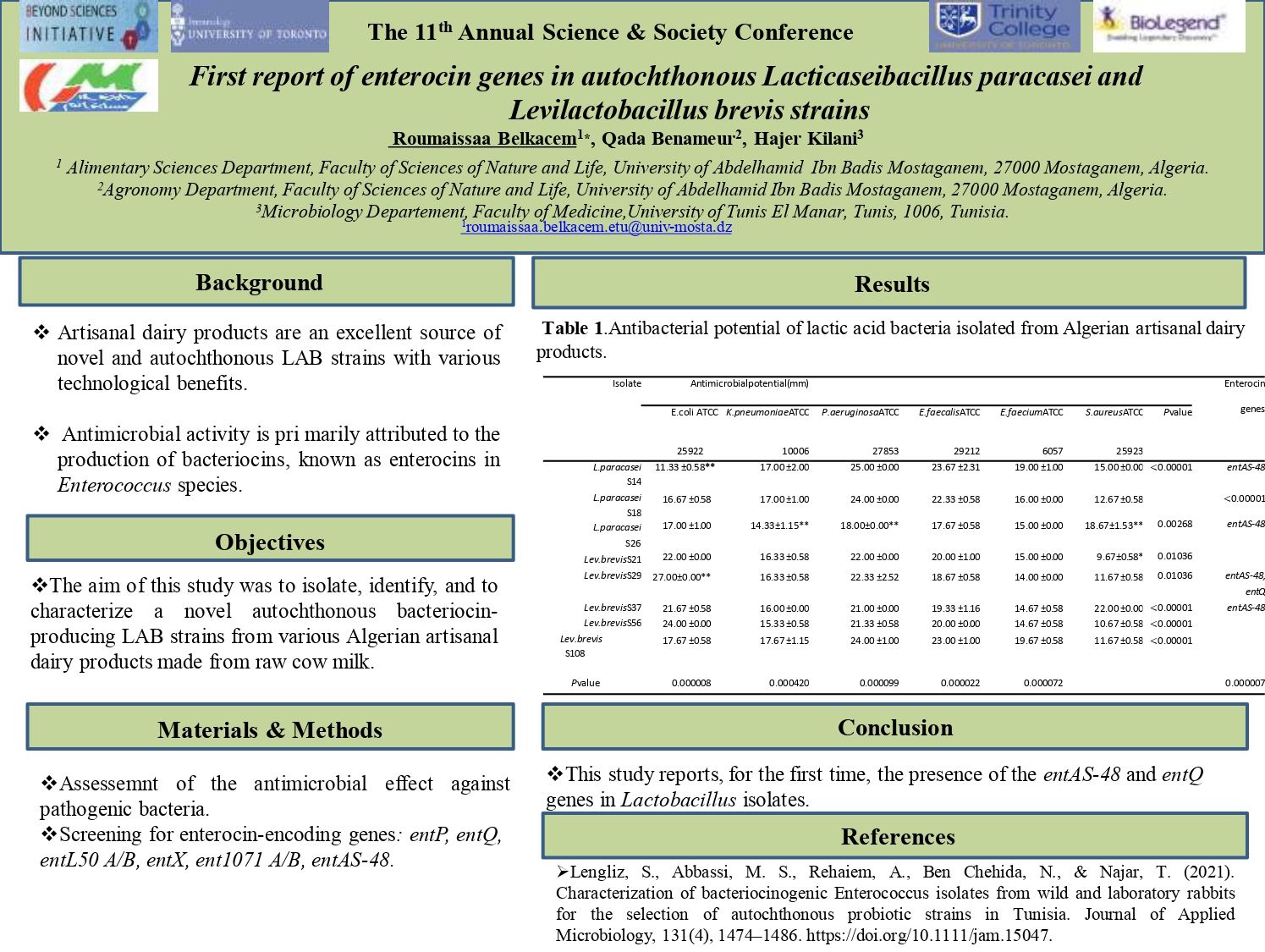
First report of enterocin genes in autochthonous Lacticaseibacillus paracasei and Levilactobacillus brevis strains
Roumaissaa Belkacem1, Qada Benameur2, Smaranda Cr˘ aciun3, George Cosmin Nad˘as3, Adriana Gy¨ orke 4, Hajer Kilani5.
1.Laboratory of Sciences and Techniques of Animal Production, Faculty of Nature and Life Sciences, University Abdelhamid Ibn Badis of Mostaganem, 27000,
Mostaganem, Algeria
2. Laboratory of Agrobiotechnology, Genetic Resources, and Modelling, University Abdelhamid Ibn Badis of Mostaganem, 27000, Mostaganem, Algeria.
3.Department of Microbiology, Immunology and Epidemiology, Faculty of Veterinary Medicine, University of Agricultural Sciences and Veterinary Medicine, 400372,
Cluj-Napoca, Romania.
4. Department of Parasitology and Parasitic Diseases, Faculty of Veterinary Medicine, University of Agricultural Sciences and Veterinary Medicine, 400372, Cluj-Napoca,
Romania.
5. Research Laboratory «Antimicrobial Resistance» LR99ES09, Faculty of Medicine of Tunis, University of Tunis El Manar, Tunis, 1006, Tunisia
Abstract
Background
Artisanal dairy products are widely appreciated by consumers worldwide for their rich nutritional value, functional benefits, and distinctive sensory attributes.
Methods
Eighteen autochthonous bacteriocin-producing lactic acid bacteria (LAB) isolated from various Algerian artisanal dairy products were identified and characterized using phenotypic and genotypic methods.
Results
MALDI-TOF analysis identified 13 isolates (72.22 %) as Lacticaseibacillus paracasei subsp. paracasei and 5 (27.77 %) as Levilactobacillus brevis. The absence of the Enterococcus-specific tuf gene in all isolates further confirmed the identification results. Most of the isolates exhibited strong antibacterial activity against six pathogenic bacteria, with inhibition zone diameters ranging from 10.67 ± 0.58 mm to 27.00 ± 0.00 mm. PCR screening for twelve enterocin-encoding genes detected the presence of entAS-48 and entQ genes in five and four isolates, respectively. Notably, one Levilactobacillus brevis isolate harbored both genes. None of the other enterocin genes were detected in the LAB isolates analyzed
Conclusions
This is the first report of enterocin-encoding genes in non-Enterococcus species, highlighting their potential as novel natural food preservatives and emphasizing Algerian artisanal dairy products as a rich source of bacteriocin-producing LAB.
Leave A Comment